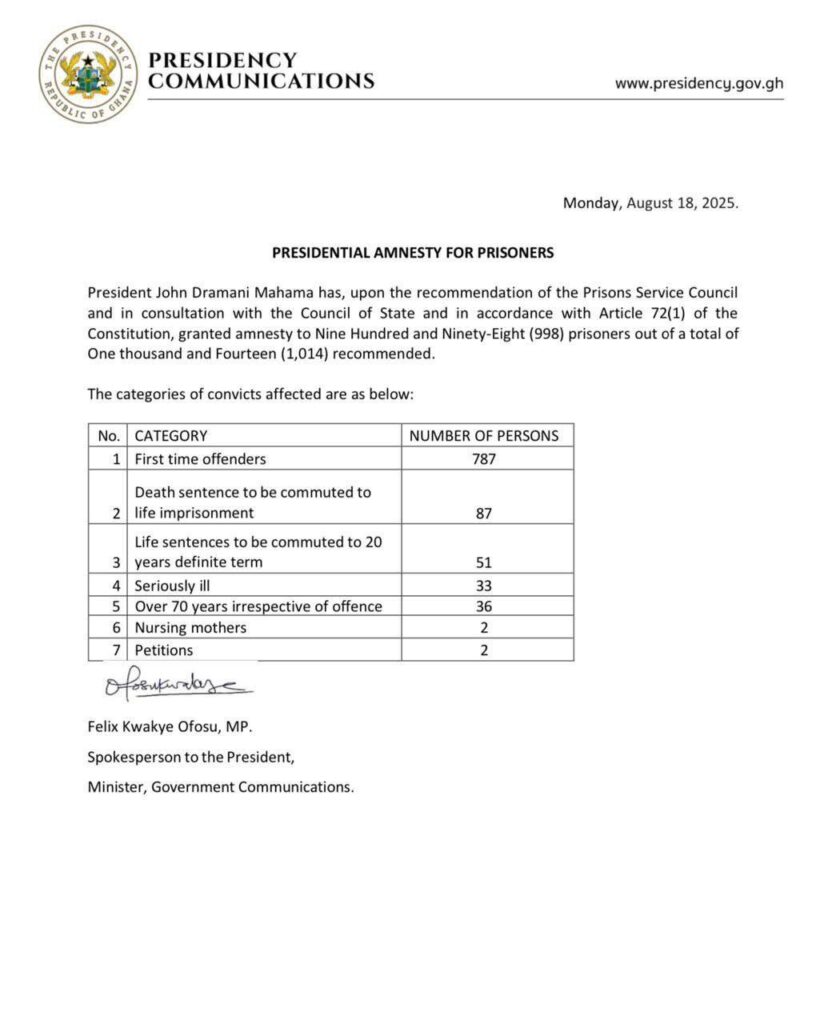
On Monday, August 18, 2025, President John Dramani Mahama exercised his constitutional prerogative of mercy by granting amnesty to 998 prisoners across the country. The decision, which was taken upon the recommendation of the Prisons Service Council and in consultation with the Council of State, is in line with Article 72(1) of the 1992 Constitution of Ghana.
According to a statement signed by Felix Kwakye Ofosu, Spokesperson to the President and Minister for Government Communications, a total of 1,014 prisoners had been recommended for clemency, out of which 998 received a presidential pardon. The categories of convicts affected highlight both humanitarian considerations and a commitment to justice reform.
The largest group to benefit is first-time offenders, totaling 787 individuals who will now have the opportunity to reintegrate into society. Another 87 prisoners on death row had their sentences commuted to life imprisonment, reflecting an ongoing shift in the country’s approach to capital punishment. Similarly, 51 inmates serving life sentences will now serve a definite term of 20 years instead.
The President’s compassion extended to those in particularly vulnerable circumstances. Thirty-three seriously ill prisoners were pardoned, alongside 36 inmates over the age of 70, irrespective of their offences. In a symbolic gesture of empathy, two nursing mothers were also released, ensuring they could care for their infants outside prison walls. Additionally, two petitions submitted to the presidency were favorably considered, bringing relief to those families.
The statement emphasized that the decision was not made lightly, but rather in the spirit of mercy and rehabilitation. “President John Dramani Mahama has, upon the recommendation of the Prisons Service Council and in consultation with the Council of State and by Article 72(1) of the Constitution, granted amnesty to Nine Hundred and Ninety-Eight (998) prisoners,” Mr. Kwakye Ofosu confirmed.
This act of clemency underscores the administration’s recognition of the challenges facing Ghana’s correctional system, including overcrowding and the need to provide second chances for those who have shown remorse and a readiness to reform. Beyond the statistics, the amnesty brings hope to hundreds of families awaiting the return of their loved ones, while also sparking a broader national conversation on justice, rehabilitation, and compassion within Ghana’s penal framework.