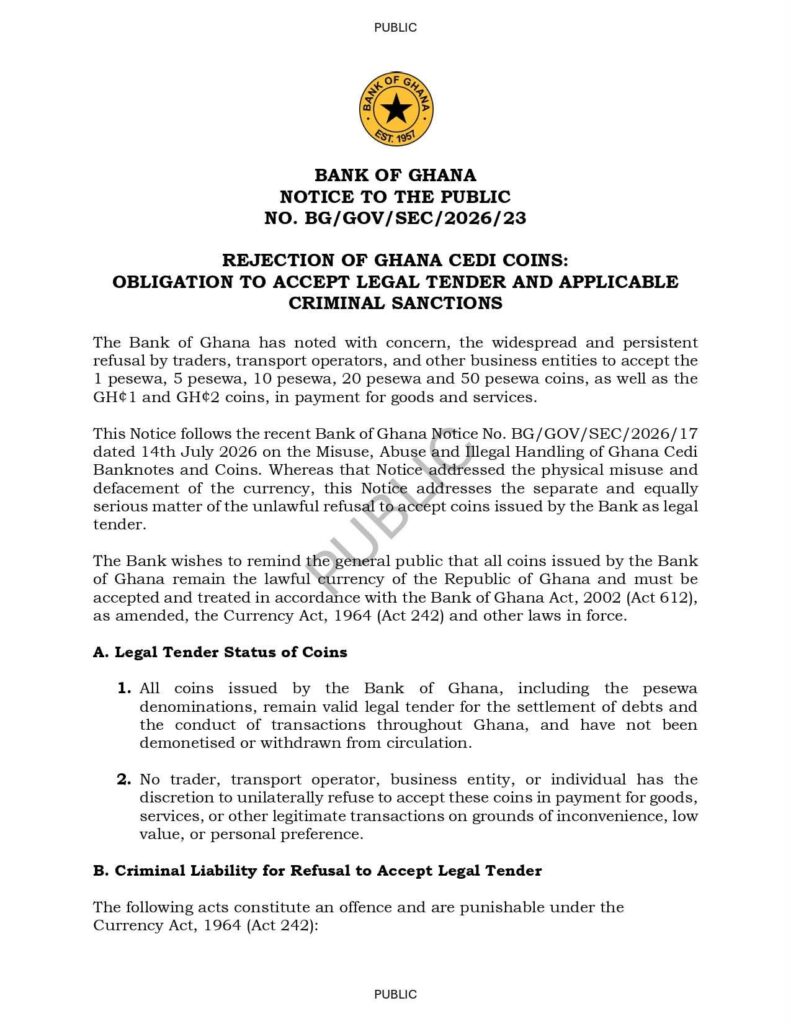
The Bank of Ghana (BoG) has warned traders, transport operators, and other businesses against refusing to accept coins issued by the central bank, describing the practice as unlawful and punishable under Ghana’s laws.
In a notice issued on Wednesday, July 22, 2026, the central bank expressed concern over the “widespread and persistent refusal” by some members of the public and businesses to accept 1 pesewa, 5 pesewa, 10 pesewa, 20 pesewa, and 50 pesewa coins, as well as GH¢1 and GH¢2 coins, for payments.
The BoG said the refusal to accept coins as payment is separate from the earlier concerns raised over the misuse and defacement of Ghana’s currency.
“Whereas that Notice addressed the physical misuse and defacement of the currency, this Notice addresses the separate and equally serious matter of the unlawful refusal to accept coins issued by the Bank as legal tender,” the statement said.
The central bank reminded the public that all coins issued by the Bank of Ghana remain legal tender and must be accepted in accordance with existing laws, including the Bank of Ghana Act, 2002 (Act 612), as amended, and the Currency Act, 1964 (Act 242).
According to the BoG, refusing to sell goods or provide services to a customer solely because the person is paying with valid coins or banknotes constitutes an offence, except in cases where the currency has ceased to be legal tender.
The Bank warned that persons found guilty of the offence could face imprisonment for up to three years, a fine, or both.
It also cautioned business owners who instruct employees to reject coins that they could be held liable in the same manner as those who commit the offence directly.
“Deliberately encouraging, helping, or instructing another person to commit this offence is punishable in the same way as if that person had committed the offence in person,” the BoG stated.
The central bank further noted that individuals found in the act of rejecting legal tender may be arrested without a warrant.
The BoG has therefore urged traders, businesses, and the general public to comply with the law, warning that persistent refusal to accept valid coins could lead to arrest, prosecution, fines, or imprisonment.