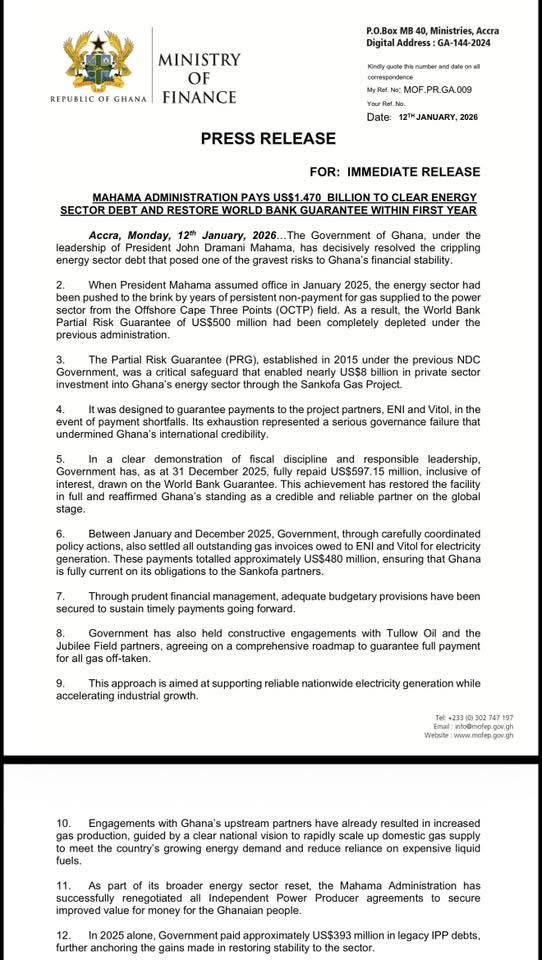













The Government of Ghana has announced a major turnaround in the country’s energy sector, revealing that a total of US$1.47 billion in legacy energy-related debts was cleared in the 2025 fiscal year.
According to a statement issued by the Ministry of Finance on Monday, January 12, 2026, the intervention has removed one of the most serious threats to Ghana’s financial and energy stability.
The statement explained that when President John Dramani Mahama assumed office in January 2025, the energy sector was already in deep distress. Years of persistent non-payment for gas supplied from the Offshore Cape Three Points (OCTP) field had pushed the sector “to the brink,” creating knock-on effects for electricity generation, investor confidence, and public finances. As a result of these payment failures, the World Bank Partial Risk Guarantee (PRG), a crucial financial backstop, had been completely exhausted under the previous administration.
The PRG, which was established in 2015 under a previous NDC government, played a pivotal role in Ghana’s energy development. It enabled nearly US$8 billion in private sector investment into the energy sector through the Sankofa Gas Project. Designed to guarantee payments to project partners ENI and Vitol in the event of shortfalls, the guarantee was described by the Ministry as a “critical safeguard.” Its depletion, therefore, “represented a serious governance failure that undermined Ghana’s international credibility.”
In what the Ministry termed “a clear demonstration of fiscal discipline and responsible leadership,” the government moved swiftly to reverse the situation. By December 31, 2025, Ghana had fully repaid US$597.15 million, inclusive of interest, that had been drawn on the World Bank Guarantee. This repayment restored the facility in full and, according to the statement, “reaffirmed Ghana’s standing as a credible and reliable partner on the global stage.”
Beyond the World Bank guarantee, the government also settled all outstanding gas invoices owed to ENI and Vitol for electricity generation. Between January and December 2025, payments totalling approximately US$480 million were made, ensuring that Ghana is now fully up to date on its obligations to its Sankofa partners. The Ministry added that adequate budgetary provisions have been secured to sustain timely payments going forward.
The reset has extended to other key players in the energy value chain. Government held what it described as “constructive engagements” with Tullow Oil and the Jubilee Field partners, agreeing on a comprehensive roadmap to guarantee full payment for all gas off-taken. This approach, the statement noted, is intended to support reliable nationwide electricity generation while accelerating industrial growth.
As confidence gradually returns, engagements with upstream partners have already led to increased gas production. These efforts are guided by a national vision to rapidly scale up domestic gas supply, meet growing energy demand, and reduce dependence on expensive liquid fuels.
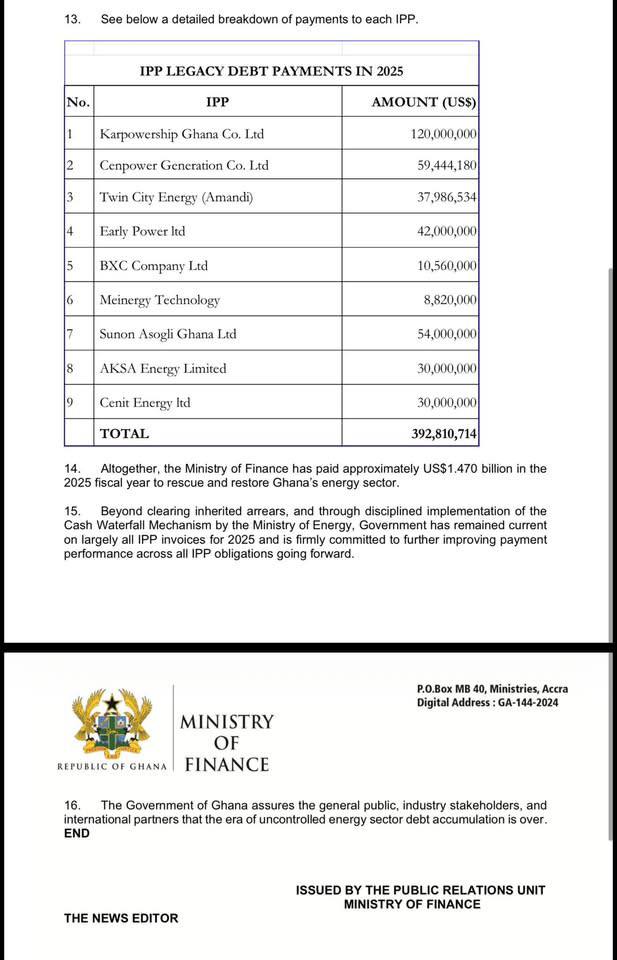
A major component of the debt clearance involved legacy obligations to Independent Power Producers (IPPs). As part of a broader energy sector reset, the Mahama administration successfully renegotiated all IPP agreements to secure improved value for money for Ghanaians. In 2025 alone, the government paid about US$393 million in legacy IPP debts, including payments to Karpowership, Cenpower, Amandi, Early Power, Sunon Asogli, AKSA Energy, and several others.
In total, the Ministry of Finance confirmed that approximately US$1.470 billion was paid in 2025 to rescue and restore Ghana’s energy sector. The government believes this decisive intervention has laid a stronger foundation for stable power supply, renewed investor confidence, and long-term economic growth.